
Should You Hire or Automate? Claude Code and Your Ops Team
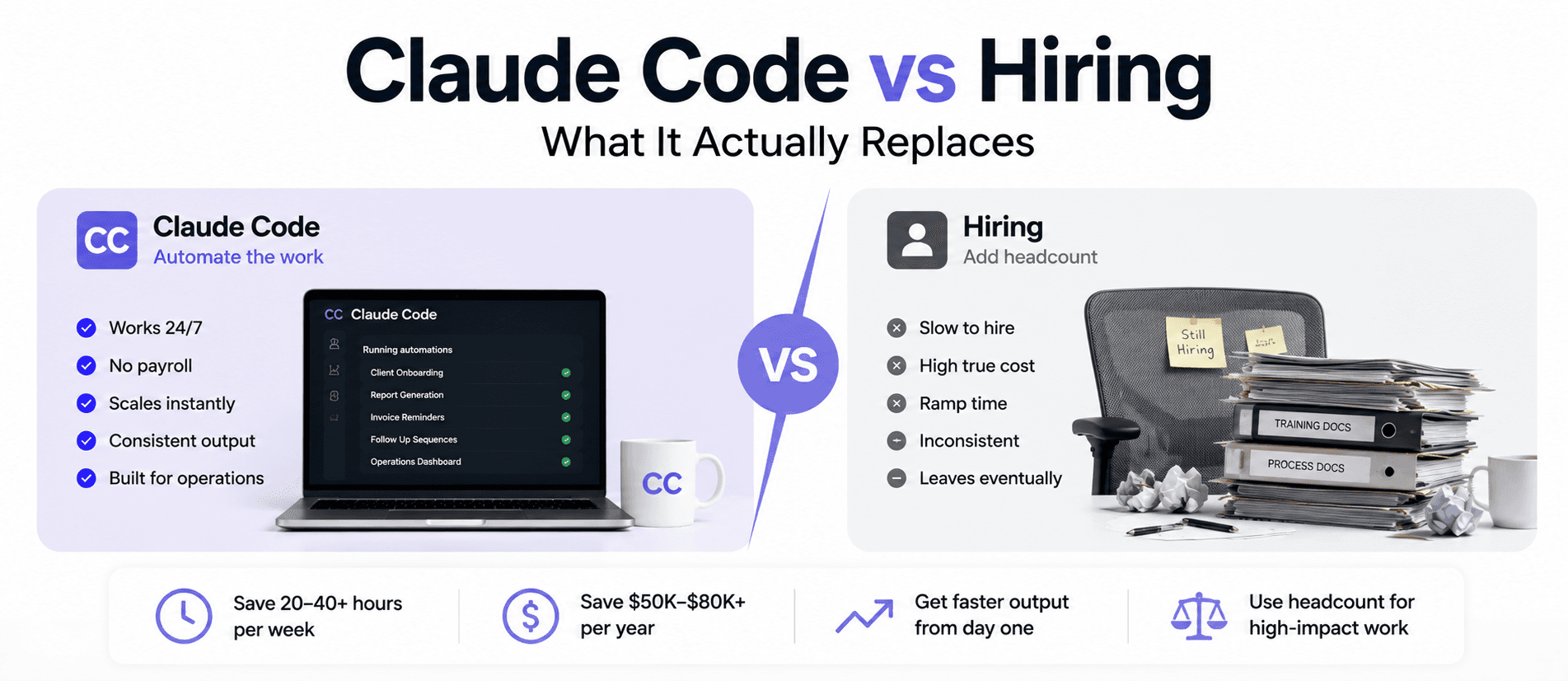
The question is not whether to hire or automate. It is which specific hours you pay $50/hr for…
Read moreJahanzeb Khan
Founder
13 min read
I tell operations directors that the most expensive work in their business is the work that looks cheap to do. Data entry. Manual reporting. Reformatted spreadsheets. Then I show them what the same work costs when it runs on automation. I should know. Wolf Nocode Studio runs on exactly that system. Here is the complete picture.
I've shipped 25+ no-code and AI-powered products since 2020. Every system I recommend to a client, I run inside my own studio first. That is not a marketing principle. It is a quality standard.
If I tell a COO that Claude Code can replace 15 hours of manual operations work per week, I should be able to show my own books. So here they are.
What follows is the complete picture of how Wolf Nocode Studio runs its operations on Claude Code. The workflows that save time. The ones that surprised me. The one that failed on first attempt and what we changed. And the actual hours recovered every week.
I call this the No-Human-in-the-Loop Standard: if a task can be defined by its output and produces the same result from the same inputs every time, no human should be in the execution loop. The human should be doing the work that only a human can do.
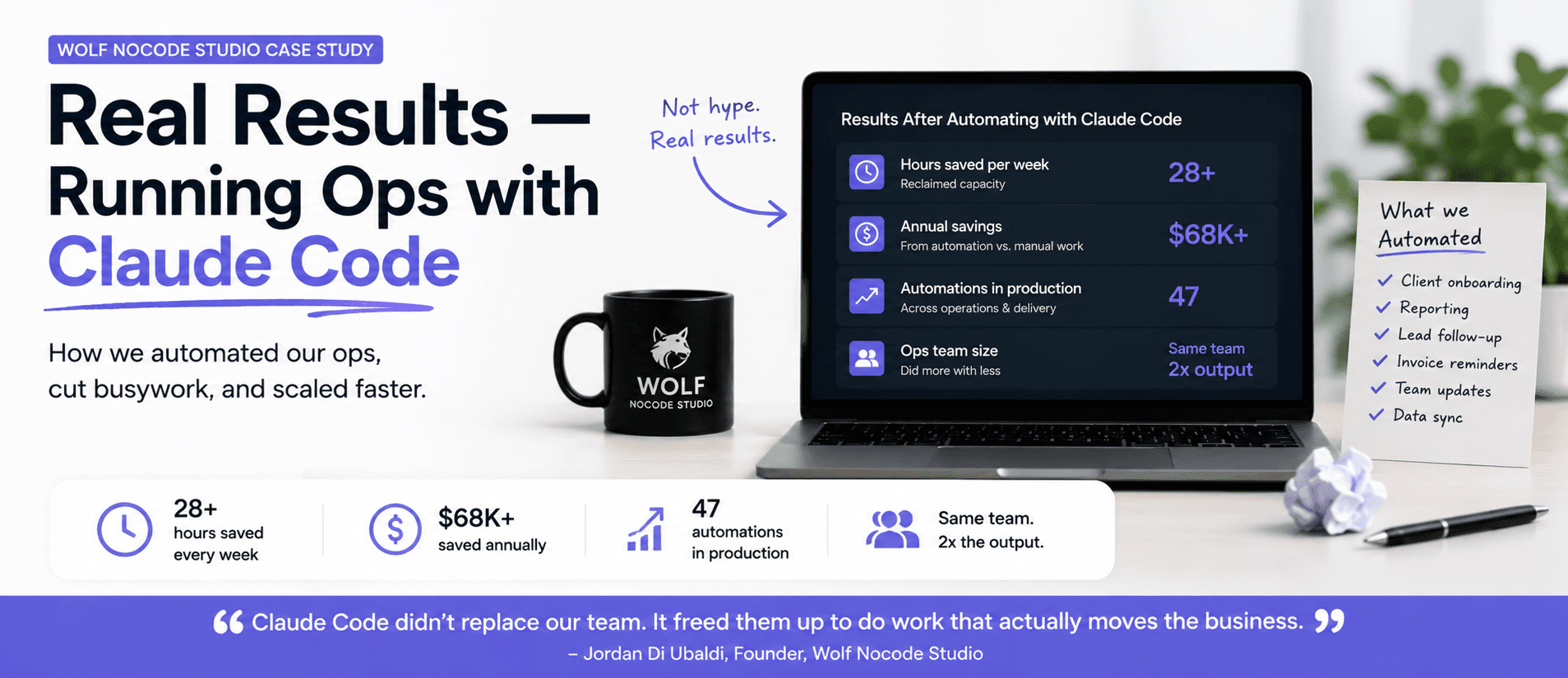
At Wolf Nocode Studio, that standard currently saves us 18 to 22 hours per week. Here is exactly where those hours come from.
Every client meeting used to end the same way. I'd be on the call, trying to listen and take notes at the same time, writing abbreviated shorthand I'd have to decode later, and then spending 30 to 45 minutes after the call creating Linear tasks for the team from those notes.
Now: every call is transcribed automatically. Claude Code reads the transcript, identifies every decision, action item, and open question, and creates the corresponding Linear tickets with the right assignee, the right label, and the right due date. By the time the client hits end call, the tasks are already in Linear.
Time saved: 2 hours per week across 5 to 6 weekly calls. That is 100 hours per year I used to spend reformatting notes into tickets.
A scoping call with a new client used to produce: my personal notes, the client's expectations, and a 3 to 4 hour gap between the call and when we had a coherent brief to work from.
Now that gap is closed.
The scoping call is transcribed. Claude Code reads the transcript and produces a structured product plan: the core problem, the user types, the key workflows, the features required for the first version, and the questions that need answering before the build starts. That product plan becomes the brief. The brief becomes the wireframe brief. The wireframe brief goes to design the same day the call happened.
What used to take 3 to 4 hours of manual synthesis now takes 30 minutes of review and light editing.
Time saved: 5 hours per new client engaged. For a studio running 4 to 6 new projects per quarter, that is 20 to 30 hours of synthesis work per quarter recovered.
A significant part of our work is operational auditing. We go into a client's business, map every manual process, and identify what should be automated. Those audit sessions used to generate notes, voice memos, and rough sketches. Converting them into a coherent, presentable client document took 3 to 4 hours per audit.
Now: audit session recorded. Claude Code transcribes it, structures the findings, identifies the specific bottlenecks by workflow, estimates the approximate time cost of each one, and drafts the presentation outline. The final presentation is ready for client review in under an hour.
The output includes what I call the Automation Priority Stack: each manual behaviour in the business ranked by time cost, error risk, and how well-defined the output is. The top of the stack is always the first automation to build.
Time saved: 4 hours per audit. We run 2 to 3 audits per month. That is 8 to 12 hours per month of document production that now takes a fraction of the time.
Wireframes in Figma are the starting point. Translating them into high-fidelity design has always involved a gap: the wireframe exists, but the design needs to incorporate brand guidelines, spacing rules, typography decisions, and component logic that isn't captured in the low-fidelity version.
Claude Code reads the wireframe notes and the brand file, identifies the design decisions that need to be made before high-fidelity begins, and produces a design brief our designer can work from directly. No back-and-forth to extract the implicit decisions from a wireframe. No lost week of iteration because a spacing decision wasn't made upfront.
Time saved: 2 to 3 hours per project in design handoff time alone.
Every morning used to start the same way. Check Gmail for anything urgent. Check Slack for anything from the team. Open Linear to see what was blocked. Then try to synthesise all three into a coherent picture of what the day actually needed.
That fragmented 45-minute context-switch is gone.
Now: Claude Code reads Gmail, Slack, and Linear every morning and generates a single daily standup brief. Open items from Gmail. Blocked tickets from Linear. Anything the team flagged in Slack overnight. One document. Three minutes to read. I walk into the day knowing exactly what matters without opening a single app.
Time saved: 45 minutes per day. Roughly 3.75 hours per week of fragmented context-switching collapsed into a 3-minute morning brief.
This one surprised me most.
A significant part of what I know about building no-code and AI products lives in conversations. WhatsApp messages to clients explaining a build decision. Slack threads where I've articulated a framework for the first time. Voice notes to myself after a discovery call.
Claude Code reads those conversations and identifies the insights worth publishing. It drafts LinkedIn posts and X threads in my voice, using the specific language from the original conversation. I edit, approve, and post. Three hours of content creation per week compressed into 30 minutes of review.
The article you are reading right now was outlined from a combination of three client conversations, a Slack thread with my team, and two voice notes I recorded after discovery calls this month.
Time saved: 2.5 to 3 hours per week of content production. Zero creativity spent staring at a blank page.
Invoicing is not glamorous. It is also not complex. A project hits a milestone. An invoice goes out. The client pays. The record updates.
Before Claude Code, I was generating invoices manually, formatting them, sending them, and tracking payment in a spreadsheet. A process with 6 steps that should have had 1.
Now: milestone hit, Claude Code generates the invoice from the project template, sends it to the client via email, and logs the expected payment in the tracker. I get a notification. The client gets an invoice. The record updates automatically.
Time saved: 1.5 hours per week. Roughly $3,900 per year at $50 per hour. For a task that requires zero judgment to execute.
This is where Claude Code started for me before I moved it into operations.
Every Bubble build has JavaScript components. Custom functions, API integrations, complex conditional logic. Writing that JavaScript used to take 2 to 3 hours per feature. Now it takes 20 to 30 minutes. Claude Code writes the function, explains what it does, and flags the edge cases I should test before pushing to production.
I still review it. I still understand what it does. But the production time is a fraction of what it was.
For our team, that is 3 to 4 hours saved per feature that has a custom JS component. Across a typical 6 to 8 week build, that is 15 to 20 hours of development time recovered per project.
This applies to our clients too. The AI Resume Parser we built for a global advisory firm processed 50 to 300 resumes per position with a private AI instance. Hiring cycle from days to 2 hours. 5 manual review stages reduced to 1. Built in 4 weeks. Still in active use today. The speed came from not writing everything from scratch. Read the full AI Resume Parser case study.
| Workflow | Hours saved per week |
|---|---|
| Meeting notes to Linear tasks | 2 hrs |
| Scoping to product plans and wireframes | 1.5 hrs (averaged) |
| Audits to client presentations | 2.5 hrs (averaged) |
| Wireframes to high-fidelity design briefs | 0.75 hrs |
| Daily standup brief | 3.75 hrs |
| Content from conversations | 2.5 hrs |
| Invoicing | 1.5 hrs |
| Coding and JavaScript for Bubble | 4 hrs |
| Total | ~18.5 hrs/week |
At my effective rate, 18.5 hours per week represents roughly $48,000 per year in billable time recovered. Some of that goes back into client work. Some into the studio's content and growth. None of it goes into manual tasks that should not require a human in the first place.
The first version of the daily standup brief was too long. It summarised everything rather than prioritising. I had to read 600 words to find the 3 things I actually needed to act on.
The fix was to redefine the output. Not "summarise Gmail, Slack, and Linear." Instead: "Give me the 3 things that need my attention today, the 2 things my team is blocked on, and 1 thing from yesterday I have not replied to." A fundamentally different brief. The second version takes 3 minutes to read.
The lesson: Claude Code produces what you specify. If the output specification is vague, the automation will produce vague outputs reliably. The fix is always the same: define what finished looks like before you build. A one-page description of the final document is worth more than a 10-step description of the current manual process.
Wolf Nocode Studio is a small studio. The scale of what I am describing is 18 to 22 hours per week across one founder and a small team.
A 30 to 70 person service business running the same workflows at scale recovers proportionally more. A 10-person ops function running 5 of these 8 workflows saves 60 to 80 hours per week across the team. At $50 per hour, that is $156,000 to $208,000 per year in manual labour recovered. Every year.
The methodology is identical at any size. Start with the most expensive manual task. Define the finished output. Build the agent. Monitor the first 3 outputs. Adjust the specification. Move to the next one.
The studio that builds automation for other businesses runs entirely on automation. If you recognise your own Monday morning somewhere in this article, the conversation starts with your specific workflow. See the 7 operations to automate first.
We help ops teams at growing service businesses build the same automated operating layer described in this article. The first step is always the same: map what your team does manually every week and calculate what it costs. If your team is spending more than 10 hours per week on work that produces the same output from the same inputs, that is where we start.
The 8 workflows described here were built over 3 months, one at a time. Each took between 2 and 5 days to build, test, and refine. The daily standup brief required 3 iterations to get the output specification right. Start with one workflow, not all 8. The second workflow is always faster to build than the first.
Not for most workflows. The meeting notes to Linear workflow, the invoicing automation, and the content repurposing workflow require no code. The Bubble JavaScript workflow and the deeper multi-tool integrations require technical setup. For non-technical ops teams, starting with the no-code-adjacent workflows is the right entry point.
The studio runs on Claude Code and Claude Cowork for the agent layer, Linear for project management, Notion for documentation, Gmail and Slack for communication, Figma for design, and Bubble for product builds. All of these connect to Claude Code via MCP connectors that read and write across the tools without manual switching.
Yes, with appropriate review. Proposal drafts, scope of work documents, and client status updates are all drafted by Claude Code and reviewed by a human before sending. The agent handles the 80 percent of the document that is templated. The human handles the 20 percent that requires judgment about the specific client relationship and context.
Automating a poorly defined process. If the output specification is vague, the automation will produce vague outputs consistently and reliably. The fix is always to define what finished looks like before you build. A one-page description of the final document is worth more than a 10-step description of the current manual process you are trying to replace.
A single workflow automation typically costs $2,000 to $3,000 at our quick-build price point. A full integrated operating layer covering 5 to 8 workflows is an $8,000 to $10,000 project. The breakeven on a single workflow typically lands within 2 to 4 months, depending on how expensive the manual version of that task currently is.
Security depends on how the agent is configured. At Wolf Nocode Studio, client data stays within the connected MCP tools and is not transmitted to third-party servers outside the approved stack. The AI Resume Parser we built for an enterprise client runs on a private OpenAI instance with zero data exposure outside the client's environment. Security is a design decision built in from the start, not an afterthought.
Jahanzeb Khan is the founder of Wolf Nocode Studio. He has built 25+ no-code and AI-powered products since 2020 for funded startups, enterprise teams, and first-time founders using Bubble, v0, Cursor, Lovable, and n8n.
The question is not whether to hire or automate. It is which specific hours you pay $50/hr for…
Read more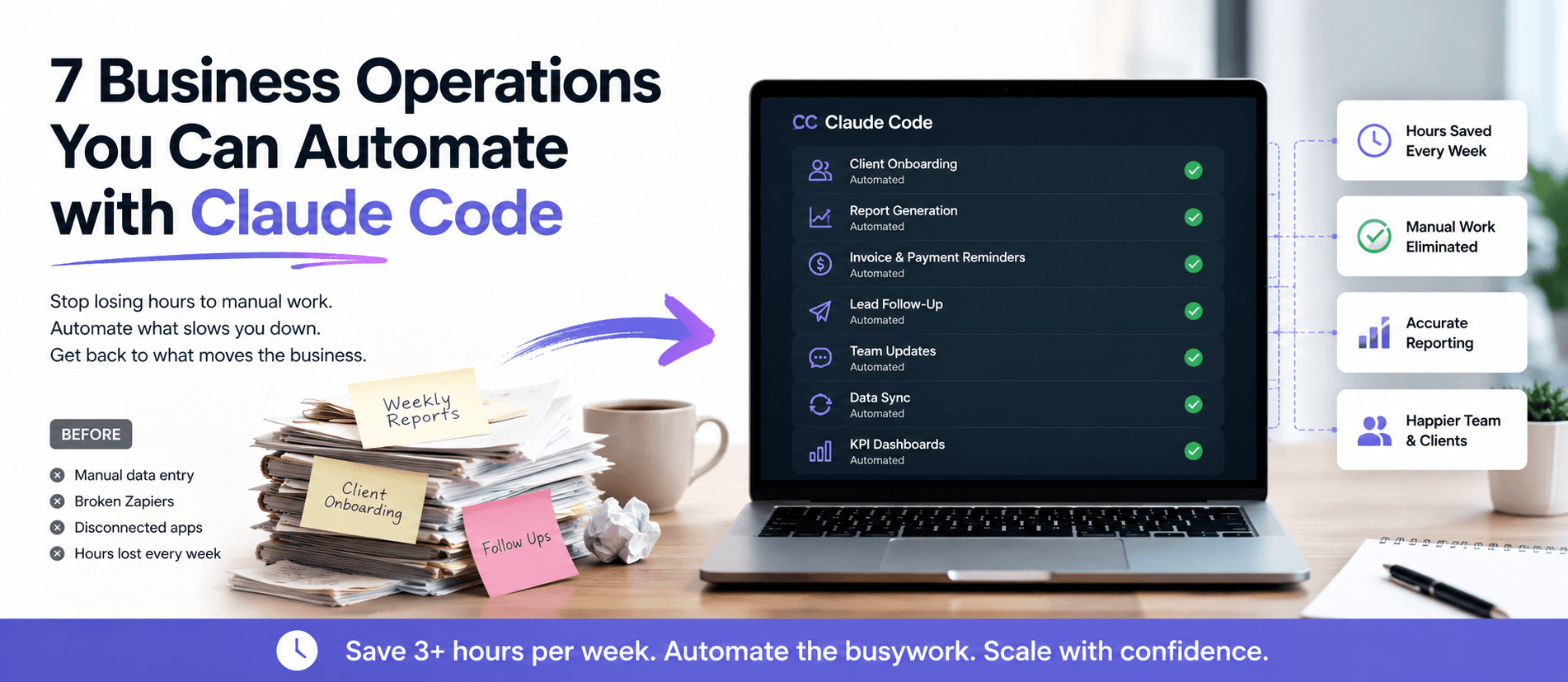
Your ops team spends hours each week on work that should already run itself. Here are 7 specific…
Read more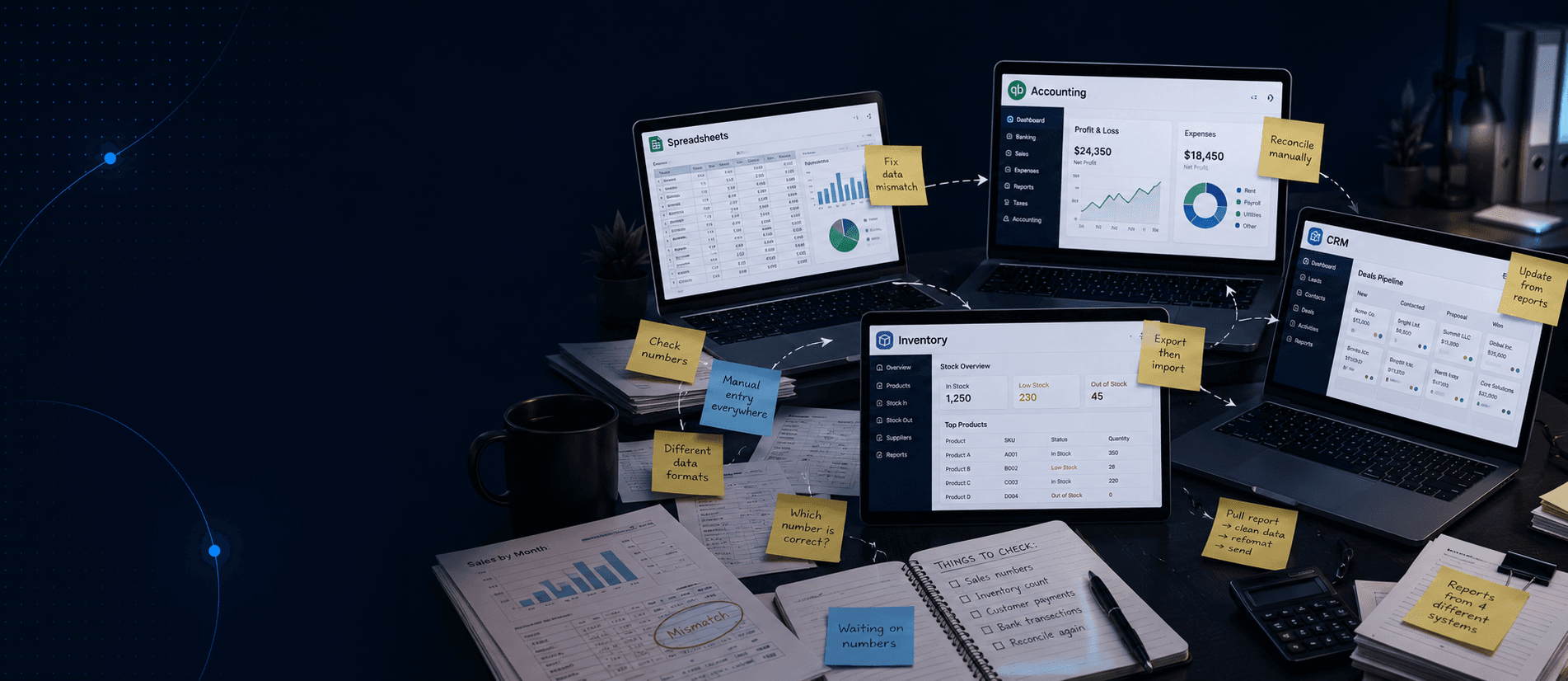
Outgrowing QuickBooks isn't about size — it's about operational complexity. Here are the real…
Read more