
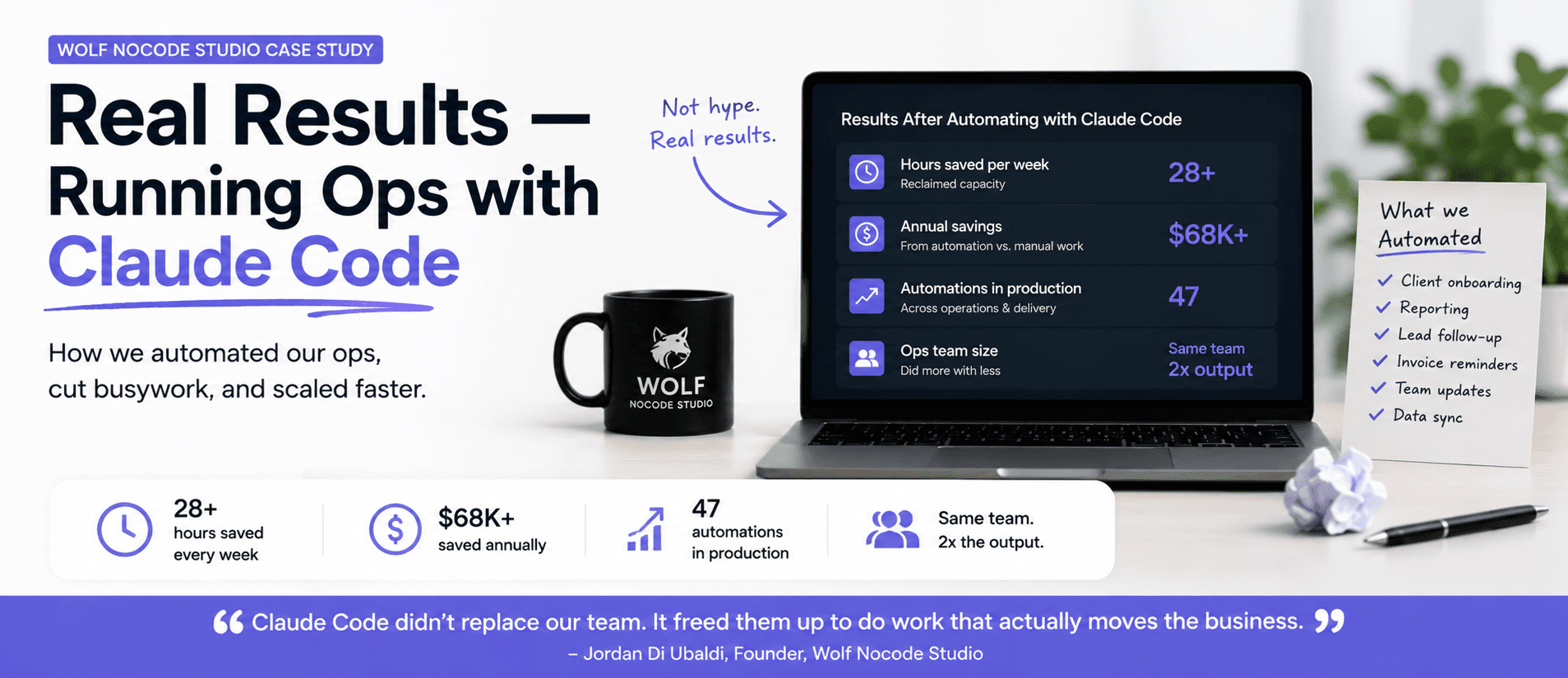
How I Run My Agency on Claude Code: Wolf Nocode Case Study
Wolf Nocode Studio builds automation for growing businesses. Here is exactly how we run our own…
Read moreJahanzeb Khan
Founder
12 min read
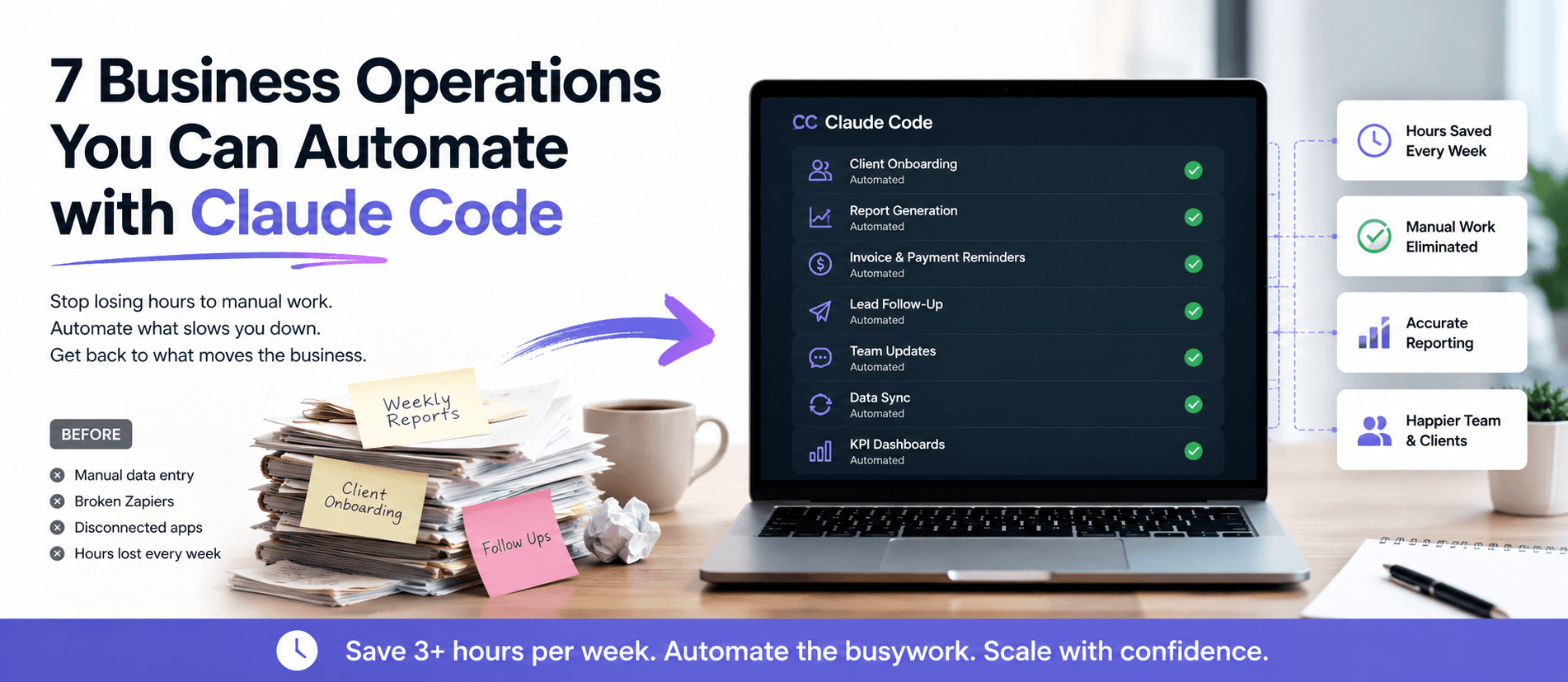
Your team starts every Monday in a spreadsheet nobody likes and nobody has replaced. They pull numbers from three tools, reformat them, and get the scorecard to the L10 twenty minutes late. That process is costing you more than the salary of the person running it. Here are the 7 operations Claude Code eliminates first.
Manual work compounds. Three operations people spending 3.6 hours each week on data work you could automate costs over $27,000 per year in labour going toward tasks that produce nothing strategic. The scorecards come out late. The reports come out wrong. The CEO asks for a number and the answer takes 22 minutes.
The problem is not your team. The problem is the infrastructure around them.
I call this The Middleware Cost Framework. Every hour a skilled operations person spends moving data between tools they didn't build is an hour of middleware cost. It is the most expensive kind of waste in a growing business because it scales directly with headcount. Hire more people and the middleware cost grows with them.
Claude Code is an AI agent that connects to your tools, reads your data, and executes workflows on a schedule. Not a chatbot you query once and paste the answer from. An autonomous agent that runs the same process every Monday morning before your team sits down.
Claude Code is not ChatGPT. You don't type questions into it and copy the responses. It connects to your actual tools via MCP connectors: Notion, Slack, Linear, Gmail, HubSpot, Asana, QuickBooks. It reads your data, writes documents, and sends outputs to the right places on a schedule you define.
The difference from Zapier matters. Zapier is trigger-action. Event A happens, action B fires. When a field name in HubSpot changes, the Zap breaks. Claude Code is an agent. It understands context, makes decisions inside a workflow, and produces finished documents instead of just triggering events.
You don't install Claude Code yourself. You describe the workflow you need automated. We build the agent. The agent runs. You get the output.
The before: 45 to 90 minutes every Monday morning. QuickBooks, BambooHR, Asana, HubSpot. Four browser tabs. One person manually pulling numbers, reformatting columns, pasting into the scorecard template, and sending it before the L10. By the time it arrives, two of the numbers are already outdated.
The after: Claude Code connects to the same tools, pulls the required data on a schedule, formats the scorecard, and delivers it before 8 AM. Nobody touches it. The number the CEO asks for in the L10 is ready in 30 seconds because it was generated at 6 AM.
Hours saved: 1.5 to 2 hours per week. Roughly $3,900 per year at a $50/hour ops rate.
The before: A new client signs the contract. Someone manually sends the welcome pack, creates the project folder, triggers the onboarding email sequence, and schedules the kickoff call. Each step is individual. The welcome pack goes out in 4 hours on a good day. Sometimes in 4 days.
The after: Contract signed in HubSpot triggers Claude Code. Welcome email is drafted and sent. Project folder is created. Asana tasks are generated from a template. Kickoff calendar invite goes out. The whole sequence runs without a human in the loop. New clients hear from you in under an hour, every time.
Hours saved: 2 to 3 hours per client onboarded.
The before: Discovery call ends. Someone spends 3 to 4 hours pulling the call notes, opening the proposal template, writing in the client context, updating the pricing section, and exporting a PDF. Same structure every time. Same 4 hours every time.
The after: Call transcript goes in. Claude Code reads the discovery notes, identifies the client problem, populates the proposal template with the relevant context, pulls the appropriate case study, and produces a draft ready for 20 minutes of human review. Proposal goes out same day.
Hours saved: 3 hours per proposal. Send 10 proposals per month and you recover 30 hours of senior team time. Every month.
The before: You have a spreadsheet. Probably 22 rows. Each row has a certificate, a renewal date, and the person who owns it. The Zapier that was supposed to send alerts broke months ago. Nobody noticed until a compliance cert expired and a client asked. Someone now manually checks the spreadsheet every two weeks and hopes for the best.
The after: Claude Code runs a nightly scan. It reads the compliance tracker, identifies anything expiring in the next 30 days, and sends a structured alert to the right person with the renewal deadline and the link. No human trigger needed. No broken Zap. No expired cert.
Hours saved: 1 to 2 hours per week of manual monitoring. Plus the cost of a missed cert, which is never just the cert.
The before: 30 active clients. Each expects a weekly or fortnightly progress update. Each report takes 30 to 45 minutes to pull, format, and write. That is 15 hours per week going toward reports. None of those 15 hours include any actual client work.
The after: Claude Code pulls the project data from your PM tool, formats it against the client report template, generates the update, and either sends it directly or stages it for a 5-minute human review. Report generation drops from 30 minutes per client to 5 minutes per client.
Hours saved: 10 to 12 hours per week across 30 active clients. That is a full-time role recovered.
The before: The CEO asks: "What's our utilisation rate this week?" The ops director opens three tools, cross-references timesheet data with project allocations, runs a calculation in Excel, and returns a number 22 minutes later. A number she isn't fully confident in.
The after: Utilisation rate pulls from your PM tool and timesheet data on a daily schedule. It lives in the morning scorecard. Or it fires as a Slack message every Monday at 7 AM. The CEO asks the question. The answer is already there.
Hours saved: 2 to 3 hours per week of reactive reporting. More importantly: decisions get made on real data.
The before: New hire joins. The ops director walks them through the onboarding process for 45 minutes. Same walkthrough she's done 7 times this year. None of it is documented anywhere. The process lives in her head. If she leaves next month, the process leaves with her.
The after: Record the next walkthrough. Claude Code transcribes it, structures it into an SOP format, identifies the numbered steps, and produces a draft document ready for one review pass. The SOP exists now. The next hire gets a document. Not a 45-minute verbal explanation.
Hours saved: 45 minutes per new hire walkthrough. The real value is organisational resilience. Processes documented today survive the people who carry them.
| Operation | Current time cost | With Claude Code | Annual saving (at $50/hr) |
|---|---|---|---|
| Weekly scorecard | 90 min/week | 5 min/week | ~$3,500 |
| Client onboarding | 2.5 hrs per client | 30 min per client | ~$2,400 at 24 clients/yr |
| Proposal drafting | 4 hrs per proposal | 45 min per proposal | ~$8,250 at 10/month |
| Compliance tracking | 1.5 hrs/week | 10 min/week | ~$3,400 |
| Client reporting | 15 hrs/week | 2.5 hrs/week | ~$31,500 |
| Utilisation monitoring | 2.5 hrs/week | 15 min/week | ~$5,750 |
| SOP creation | 45 min per walkthrough | 10 min per walkthrough | ~$1,500 at 20 SOPs/yr |
| Total | ~$56,000/year |
That $56,000 is not money you spend. It is hours your team gets back. At a 30-person service business, that is 1,120 hours per year of manual work that stops happening.
Not all 7 at once. Start with the one where the manual work is most visible, most repeated, and most expensive.
For most ops teams, that is the weekly scorecard or client reporting. Both repeat on a fixed schedule. Both have templated outputs. Both have measurable time costs.
Here is the principle I apply before every build: The Connected Operations Principle. Individual workflows reduce hours. A connected operating layer eliminates the category of problem that was costing you those hours in the first place. When the compliance tracker feeds the scorecard, when the proposal template pulls from the case study library, when the onboarding workflow reads the CRM: you are not running 7 automations. You are running infrastructure.
I've seen this at scale. The Employee OS we built for a global advisory firm replaced 6 disconnected regional Sage instances with one unified system. 770 employees across 6 countries. 8 weeks to build the first version. Still in active use 2 years later. The brief was to fix the Sage integration. We told them not to. Why we tell clients not to patch what needs replacing.
The starting point is always the same: identify the most expensive manual task in your team's week. Define what the finished output looks like. Build from there.
We work with ops teams at growing service businesses to map the highest-cost manual workflows and build the automation layer that eliminates them. Most builds go live in 4 to 8 weeks. The first conversation is about your process, not ours.
If your team is doing more than 5 hours of manual data work every week, that is the right starting point.
Claude Code is an autonomous AI agent that connects to your business tools, reads data, executes workflows, and produces outputs on a schedule. Unlike ChatGPT, it does not just answer questions. It runs processes. For operations teams, that means automating the recurring, template-based tasks that currently require a human to execute every single time they repeat.
Zapier is trigger-action automation: event A fires action B. It breaks when upstream fields change. Claude Code is an agent that understands context, handles conditional logic, and produces finished documents rather than just triggering events. For multi-step workflows with variable inputs, Claude Code is significantly more durable than a Zap.
No. You describe the workflow you need automated and what the finished output looks like. The build happens on our end. You receive the output. Most operational automations for a 30 to 100 person service business can go live in 4 to 8 weeks without your team touching any technical layer.
A 30-person service business automating the 7 workflows in this article typically recovers between $40,000 and $60,000 per year in labour hours. That is not revenue generated. It is hours redirected. Your team stops being the middleware and starts doing the work that actually requires them to be present.
Yes. Claude Code connects to most major SaaS tools via MCP connectors: HubSpot, Asana, QuickBooks, Gmail, Slack, Notion, Linear, Google Calendar, and more. Integration is rarely the constraint. The constraint is knowing what you want the automation to produce and defining that output clearly before the build starts.
Every automated workflow needs a monitoring layer. The more durable builds are designed around your actual data structure, not around hoping upstream field names never change. A system built on your real workflow is significantly more stable than a Zapier that breaks when a HubSpot field gets renamed by a junior admin.
A single, well-defined workflow with a clear output can be built and tested in 1 to 2 weeks. More complex multi-step workflows with conditional logic and multiple tool integrations typically take 3 to 4 weeks. The constraint is almost always the quality of the output specification on the client side, not the build itself.
Claude Code works across business sizes. The 7 operations in this article apply directly to a 20 to 100 person service business. The same methodology we used to build the Employee OS at 770 employees across 6 countries applies to a 25-person staffing firm. The starting point is identical regardless of size: identify the most expensive manual workflow and eliminate it first.
Jahanzeb Khan is the founder of Wolf Nocode Studio. He has built 25+ no-code and AI-powered products since 2020 for funded startups, enterprise teams, and first-time founders using Bubble, v0, Cursor, Lovable, and n8n.
Wolf Nocode Studio builds automation for growing businesses. Here is exactly how we run our own…
Read more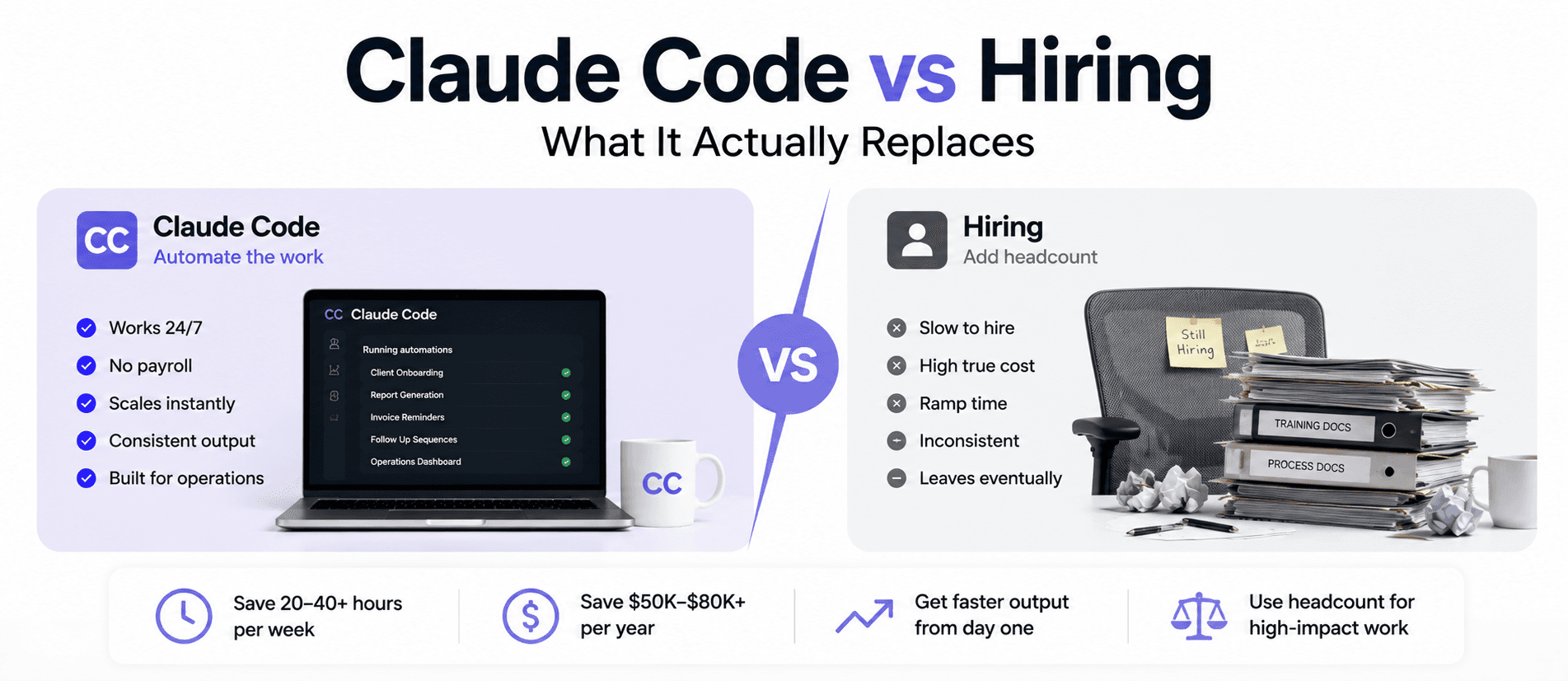
The question is not whether to hire or automate. It is which specific hours you pay $50/hr for…
Read more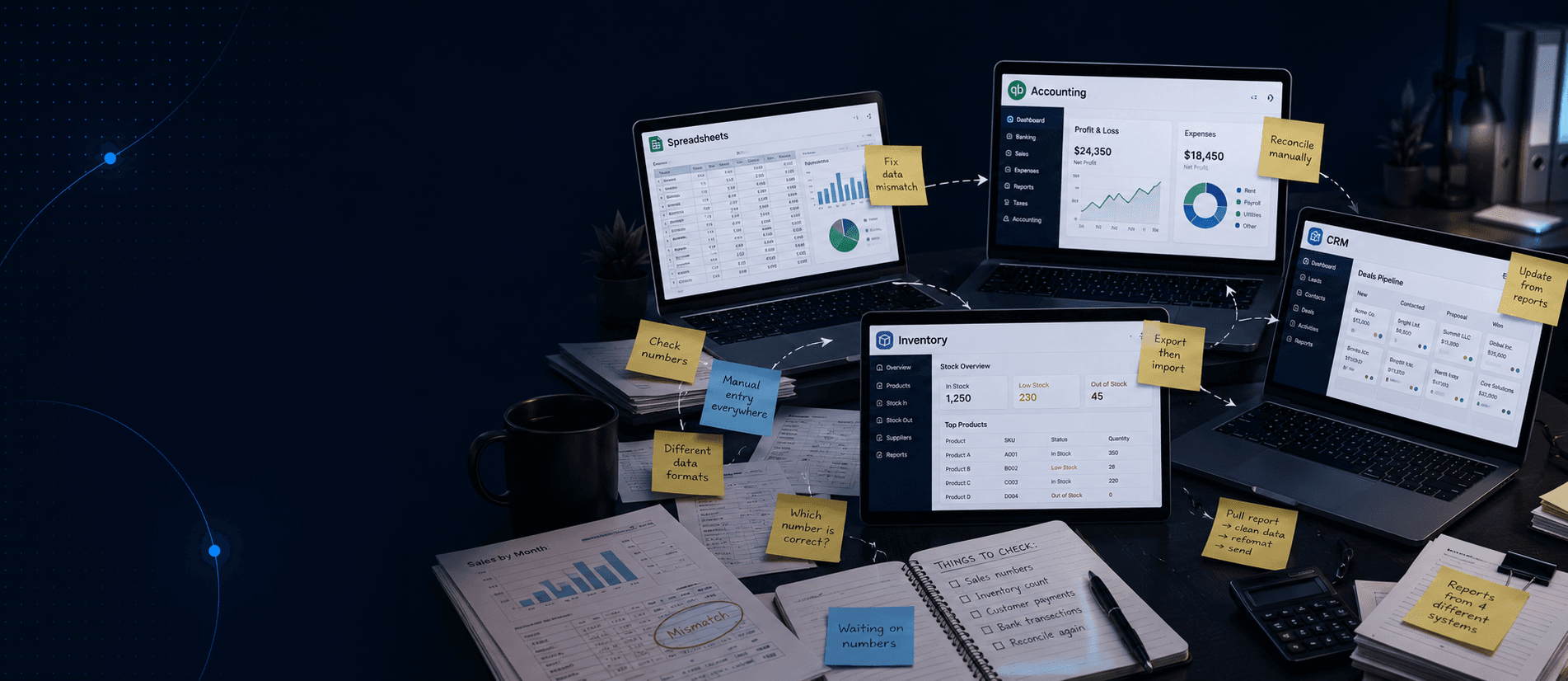
Outgrowing QuickBooks isn't about size — it's about operational complexity. Here are the real…
Read more