
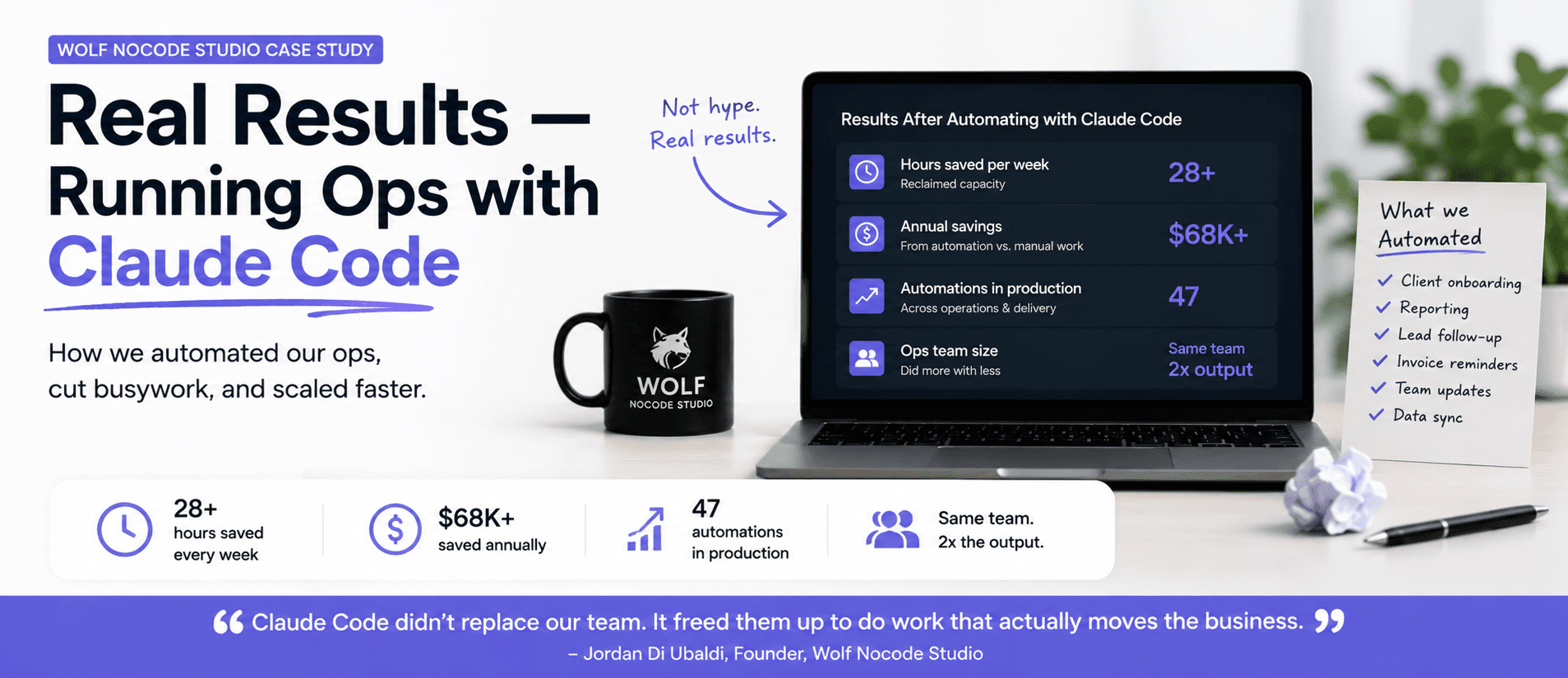
How I Run My Agency on Claude Code: Wolf Nocode Case Study
Wolf Nocode Studio builds automation for growing businesses. Here is exactly how we run our own…
Read moreJahanzeb Khan
Founder
11 min read
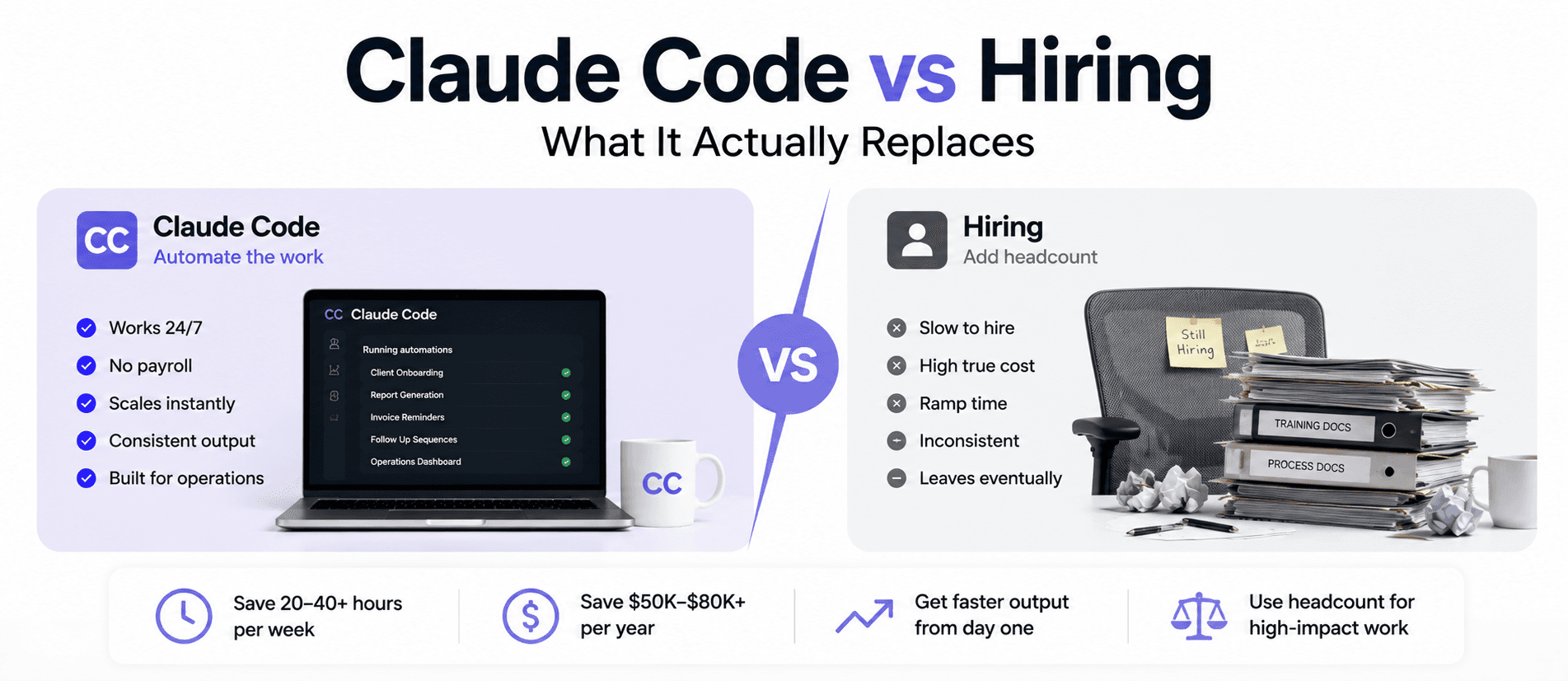
Hiring a person for a repeatable task is a tax you pay every year. Automating that task is a one-time cost. Most operations directors never calculate which of their current headcount is solving a repeatable problem, and which is solving a judgment problem. That single calculation will tell you whether to hire or automate. Here is how to run it.
Most ops leaders frame this as: "Can AI replace our team?"
That is the wrong frame. It activates defensiveness, misses the real decision, and leads to conclusions that are either too aggressive or too cautious. Neither serves the business.
The useful question is: "Which specific tasks in this team are repeatable, template-based, and producing the same output from the same inputs every week?"
Those tasks are automation candidates. Everything else stays human.
The difference between a team that answers this question and one that doesn't is $40,000 to $80,000 per year. Not in software costs. In labour going toward work that a machine can do.
I use a simple three-part test I call The ADD Framework: Automate, Delegate, or Decide.
Automate: Same inputs. Same process. Same output. Repeats on a schedule or a trigger. No judgment involved in the production. Examples: weekly scorecard assembly, compliance monitoring, client report generation, proposal first drafts, invoice generation.
Delegate: Requires human execution but not senior judgment. Email responses, calendar management, formatting and filing. Should go to a junior hire or a VA, not to your ops director.
Decide: Requires reading context, managing relationships, or making a call with incomplete information. Vendor negotiations, escalation management, strategic planning, anything where tone and relationship history matter. This is what your senior ops team should be doing all day.
The problem in most growing service businesses is that all three categories are being handled by the same person. The ops director is automating nothing, delegating nothing, and making strategic decisions in between completing tasks that should not require her attention at all.
Claude Code handles the Automate category. It does not handle the Decide category. The Delegate category depends on the specific task.
Here is the honest list. Not the marketing version.
The data assembler. The person who pulls numbers from three tools every Monday morning, reformats them, and pastes them into the leadership scorecard. Claude Code does this faster, more accurately, and without Monday morning resentment. This is repeatable work. It should not cost $50/hour to execute.
The proposal drafter. The first draft of every proposal uses the same template, the same structure, and varies only in client-specific context. Claude Code reads the discovery call transcript and produces a first draft in minutes. A human reviews and sends it. The 4 hours of drafting becomes 20 minutes of editing.
The compliance monitor. The person who checks the renewal spreadsheet every two weeks and hopes nothing has lapsed. Claude Code scans it nightly and sends alerts automatically. No human trigger needed. No expired cert at the worst possible moment.
The internal communicator. Weekly team updates, client status reports, operational digests. Claude Code generates these from live data. The format is templated. The inputs are structured. The human adds judgment where it is genuinely needed.
These are not small categories. Together, they typically represent 35 to 50 percent of the hours your ops team currently works.
This matters as much as the section above.
Relationship judgment. The vendor conversation that requires knowing when to push and when to back down. The client escalation where tone matters more than content. The internal meeting where reading the room is the entire job. These require a human who knows the history. Claude Code does not know the history.
Process design. Claude Code runs the process. It does not design it. Someone still has to decide what the workflow should be, what the output should look like, and what counts as an exception. That is ops leadership work. It gets more valuable, not less, when the execution layer is automated.
Novel situations. Every automated workflow has edge cases where a human needs to step in. A system built on your real workflow handles this by design. You define the exception paths before you build. The ops director handles exceptions. The agent handles everything else. The split is not "human or machine." It is "which parts of this workflow require human judgment?"
Trust and authority. The CEO does not ask Claude Code what to do about the client who wants to exit the contract. The decision sits with a person. What Claude Code can do is give that person a briefing document, a risk summary, and a historical context note in 2 minutes instead of 30.
| Task | Human cost/year | Claude Code | When human wins |
|---|---|---|---|
| Weekly scorecard (90 min/week) | ~$3,900 | Included in ops tooling | Never |
| Proposal first drafts (10/month) | ~$9,600 | Included in ops tooling | Never |
| Compliance monitoring | ~$3,900 | Included in ops tooling | Never |
| Client status reports (30 clients) | ~$39,000 | Included in ops tooling | Never |
| Vendor negotiations | Irreplaceable | Cannot do | Always |
| Escalation decisions | Irreplaceable | Cannot do | Always |
| Strategic planning | Irreplaceable | Cannot do | Always |
The top four rows are automation candidates. The bottom three are human work. The question is whether your team spends more time in the top rows or the bottom rows.
At most 30 to 70 person service businesses, the honest answer is mostly the top rows. The ops director is assembling scorecards when she should be interpreting them. She is drafting proposals when she should be closing them. She is monitoring compliance when she should be redesigning the process that keeps producing compliance issues.
When your ops team stops doing the work in the top four rows, something important happens. They have 35 to 50 percent of their week back.
That is not a headcount reduction. It is a reallocation.
The ops director who was spending 2 hours every Monday pulling the scorecard now spends those 2 hours on the question the scorecard is supposed to answer. The senior hire who was drafting proposals is now doing the relationship work that closes them. The person maintaining the compliance spreadsheet is now redesigning the process that keeps generating compliance issues in the first place.
When you hire after implementing automation, you hire for the Decide category. Not for execution capacity.
That is a different hire. It typically costs more per person. But you need fewer of them. And the work they do moves the business forward rather than maintaining it.
The honest answer is both. The question is sequence.
Automate first. Every hire made into a team running on manual execution adds to The Middleware Cost Framework: the compounding annual expense of paying senior rates to do work that repeats without variation. Automating first tells you exactly what you are hiring for. Most teams who automate before hiring discover they need a fundamentally different type of hire than they originally planned.
Here is the principle I apply when advising ops teams: if a task can be defined by its output and produces the same result from the same inputs every time, it should not require a person to execute it. Full stop.
The Employee OS we built for a global advisory firm is the clearest example I can point to. The brief was to fix the Sage integration across 6 regional offices. We told them not to. Connecting 6 broken systems gives you a more connected version of the same problem. We replaced Sage entirely. One unified system. 770 employees across 6 countries. 8 weeks to the first version. Still in active use 2 years later.
Four weeks after that build went live, the same client came back with the hiring process. 50 to 300 resumes per position. 5 manual review stages. Days to make a decision. We built an AI Resume Parser on a private instance. Hiring cycle dropped to 2 hours. 5 stages to 1. They did not hire more ops people to handle the volume. They automated the volume and redeployed the people they had.
That is the right sequence. See the 7 operations worth automating first.
Running an ops team on manual execution indefinitely is a tax that compounds every year. But rushing to automate without first identifying what is worth automating is equally expensive. You end up with fast, reliable versions of processes that should have been redesigned before they were automated.
The starting point is not the tool. It is the list.
Write down every repeatable task your ops team executes in a given week. Next to each one, write the approximate time it takes. Add a column: "is the output the same every time?" If yes, it is an automation candidate. Sort by time cost. The top of that list is the first automation to build.
Do that exercise before your next hire. The result will change who you are hiring for.
We help ops teams at service businesses identify the highest-cost manual workflows and build the automation layer that replaces them. The first conversation is about your process, not our product. If you are trying to figure out which parts of your operation are worth automating first, a 20-minute call will give you a clear answer.
No. Claude Code replaces specific task categories: data assembly, template-based report generation, compliance monitoring, and proposal drafting. It does not replace judgment, relationship management, or process design. The right frame is not replacement. It is reallocation of what your team spends time on each week.
Use the ADD test: Automate, Delegate, or Decide. Any task that produces the same output from the same inputs on a repeating schedule is an automation candidate. Any task that requires reading context, managing relationships, or making calls with incomplete information should stay human. Most teams find 35 to 50 percent of their week falls in the Automate category.
A mid-level operations hire in a UK or US service business costs $45,000 to $75,000 per year in salary alone. Claude Code as part of an integrated ops build typically costs $8,000 to $10,000 to set up and a fraction of that annually to run. The ROI calculation depends entirely on which tasks you are automating and at what current cost.
Reliability depends on how the system is designed. A workflow built on your actual data structure, with monitoring and exception handling built in, is significantly more reliable than a Zapier built on the assumption that upstream fields never change. The Employee OS running 770 employees across 6 countries has been in active use for 2 years without a rebuild.
Every build includes exception paths and monitoring. When the output falls outside expected parameters, the system flags it for human review instead of sending it. The most common source of wrong outputs is a vague output specification. The clearer you are about what finished looks like, the more reliably the agent produces it every time.
For most single-workflow automations, breakeven is within 4 to 6 weeks of the build going live. A weekly scorecard that takes 90 minutes to produce manually takes 5 minutes with Claude Code. At $50 per hour, that is $85 recovered per week. A $2,000 to $3,000 single-workflow build breaks even in under 6 months.
Before. Every hire made into a team running on manual execution adds to the Middleware Cost. Automating first tells you exactly what you are hiring for. Most teams who run this sequence discover they need a different type of hire than planned. Typically a more senior, more strategic person, because the execution work is now handled.
Jahanzeb Khan is the founder of Wolf Nocode Studio. He has built 25+ no-code and AI-powered products since 2020 for funded startups, enterprise teams, and first-time founders using Bubble, v0, Cursor, Lovable, and n8n.
Wolf Nocode Studio builds automation for growing businesses. Here is exactly how we run our own…
Read more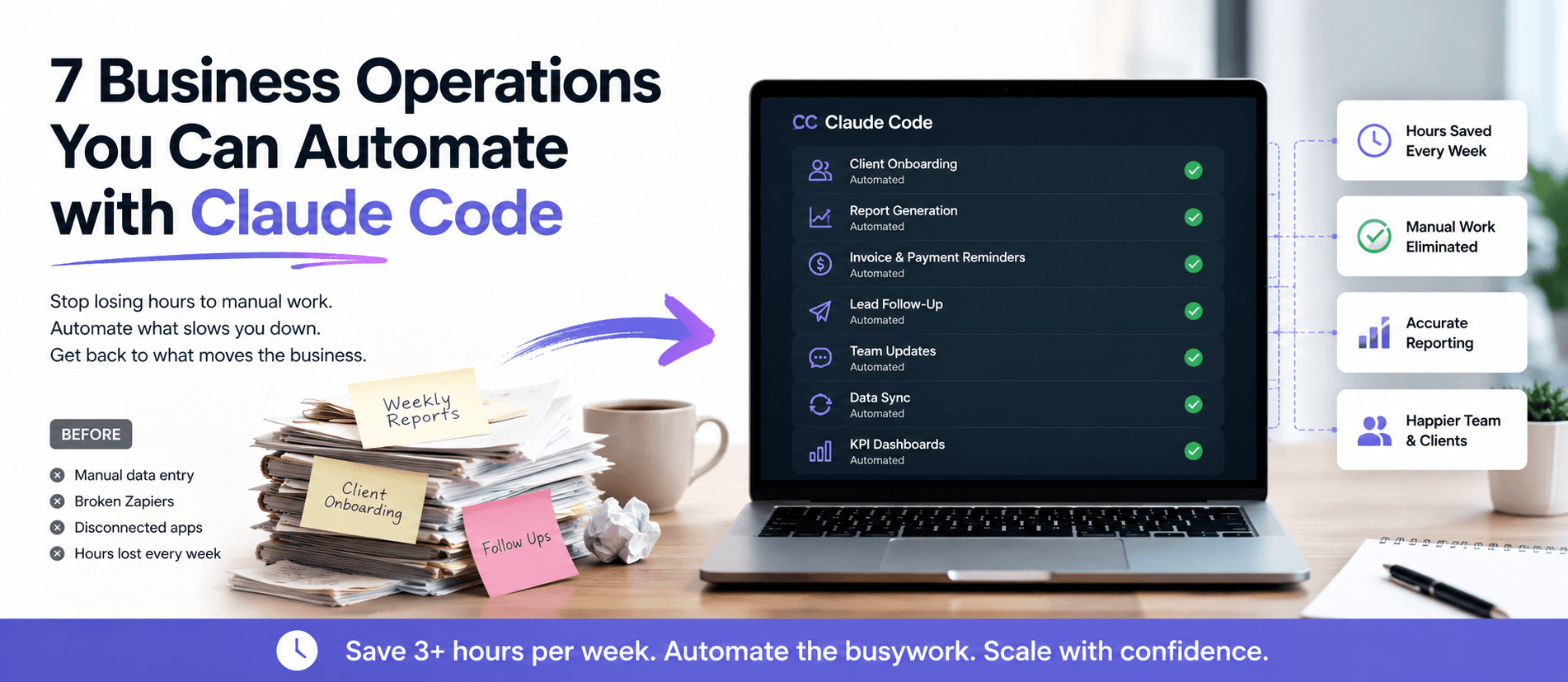
Your ops team spends hours each week on work that should already run itself. Here are 7 specific…
Read more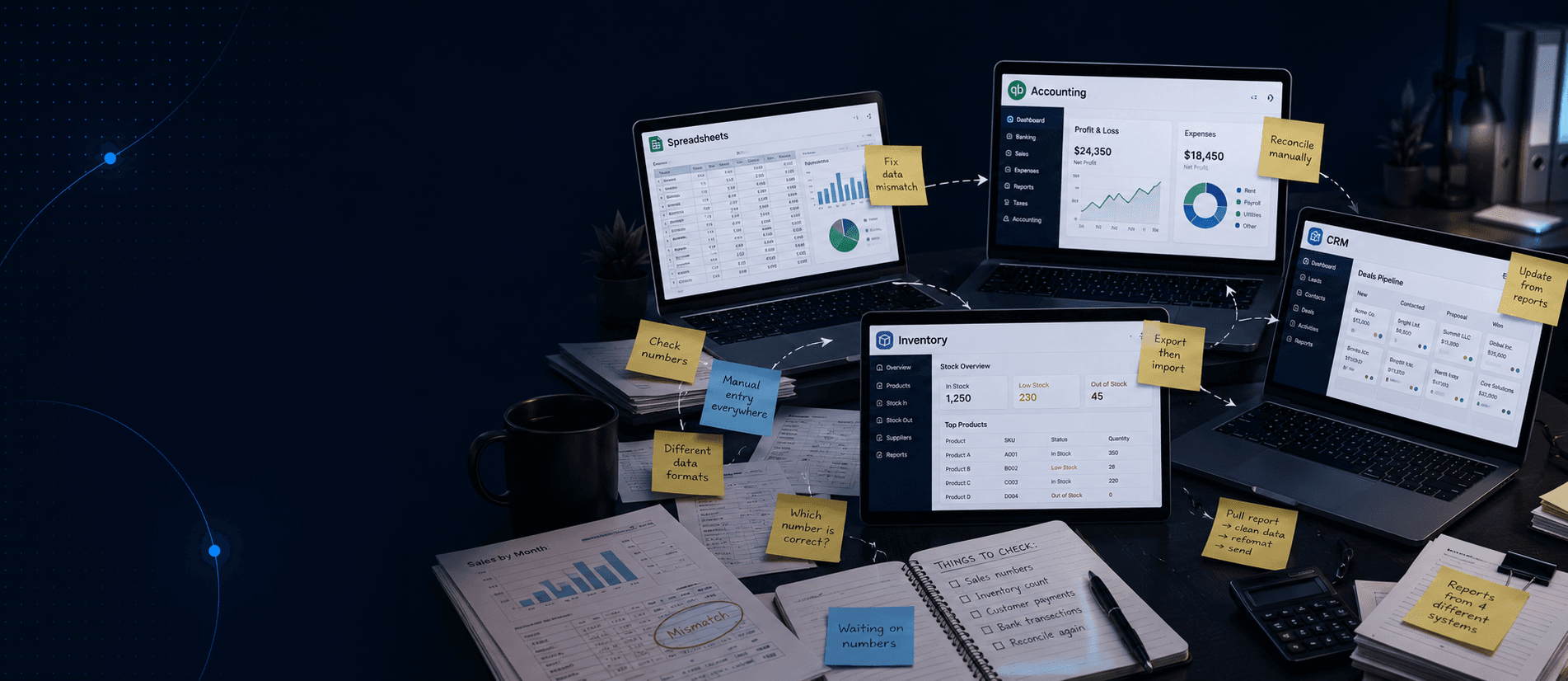
Outgrowing QuickBooks isn't about size — it's about operational complexity. Here are the real…
Read more