
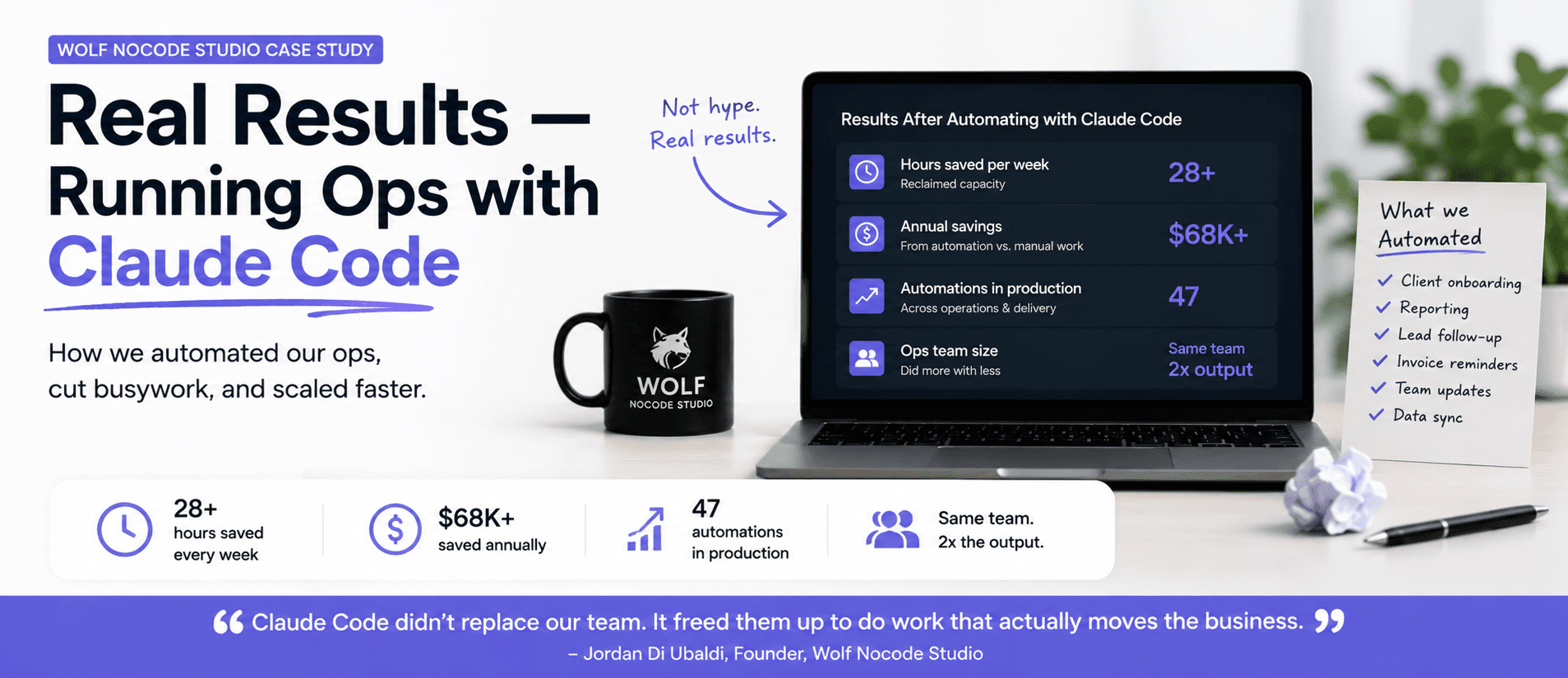
How I Run My Agency on Claude Code: Wolf Nocode Case Study
Wolf Nocode Studio builds automation for growing businesses. Here is exactly how we run our own…
Read moreJahanzeb Ahmed Khan
Founder
6 min read
Your SaaS stack costs $600 a month. You know this because it's on the credit card statement.
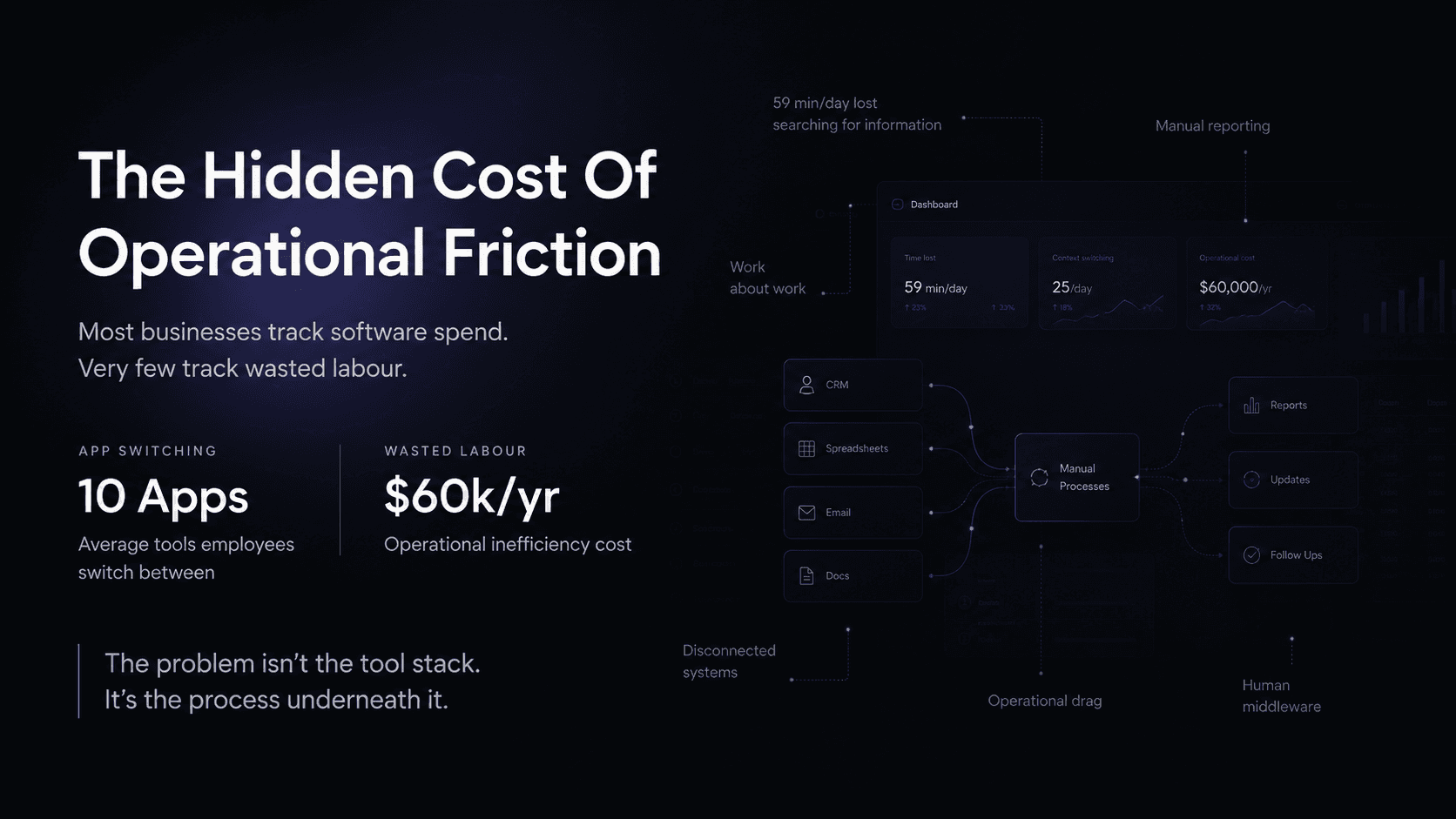
What isn't on the statement: the 59 minutes your team spends every day searching for information trapped across the wrong tools. The weekly report nobody should be manually building. The ops manager who spends Monday morning copy-pasting data between three systems that should talk to each other but don't.
That's the cost that never shows up on a budget review. Because it doesn't arrive as an invoice.
Most businesses review software costs once a year. They look at the list of tools, cross-reference what's actually being used, and cancel a few licenses.
It feels productive. It saves $200 a month.
What it doesn't touch is the real cost: the cumulative staff time lost to working around software that was never built for how the business actually runs.
Research from Cornell University found that workers spend roughly 59 minutes per day searching for information trapped across various tools. That's across everyone, not just the ops team. And the average knowledge worker devotes 60% of their time to what Asana calls "work about work": chasing updates, attending status meetings, searching for information, and switching between apps.
The skilled, strategic work the business hired people for? That gets 40% of the day.
It rarely looks dramatic. That's why it persists.
The weekly report. Someone on the team builds it manually every Monday. Pulls from the CRM, cross-references a spreadsheet, formats it in Google Slides. Takes 2 hours. Has taken 2 hours every Monday for 18 months. Nobody has asked whether it should exist or whether it could run automatically.
The handoff that creates double work. A lead comes in through the website. It gets logged in the CRM. Then re-entered manually into the ops system. Then updated again after the first call. The same data touched three times by two different people, neither of whom would describe it as their job.
The tab-switching tax. Workers toggle between an average of 10 different apps 25 times per day. Every switch has a recovery cost. Attention is split before it was ever fully given. The team looks busy. Output doesn't match effort.
The process only one person understands. A key employee hands in their notice. Suddenly nobody knows how their job actually works. It wasn't hidden. It just only ever lived inside one person's head because the system never captured it.
None of these feel expensive in isolation. Combined, across a 10-person team, they add up to something significant.
Take the weekly report example. One employee. Two hours every Monday.
That's 100 hours a year on a single report.
At a fully loaded cost of $50 per hour (generous for a US-based ops hire) that's $5,000 a year. For one report. From one person. At one company.
Now add the data re-entry. The average employee at an enterprise business does over 1,000 copy-pastes per week. In a smaller business with fewer systems, it's less, but the principle is the same. Every manual data transfer is a tax on the team's time. One that compounds every week and never appears on any software invoice.
Gartner estimates roughly 30% of global SaaS spend goes to unused or underutilised tools, but that figure doesn't capture the cost of the workarounds those tools generate. The spreadsheet someone built because the CRM couldn't quite do what was needed. The Slack thread managing something a system should handle. The three-step manual process running in parallel because nobody stopped to replace it.
That's where the real number lives. Not in the subscription. In the payroll.
The answer isn't usually to add another tool.
When tools go unused, teams default to manual workarounds, and if the root cause isn't addressed, those workarounds cost more time and consistency than the tool itself.
The first step is honest process mapping. Before any software discussion, walk through what actually happens. Not the process as it was documented at launch. The process as it runs today, with all the exceptions and workarounds and tribal knowledge baked in.
Most businesses find two things in that exercise. First: several steps exist only because the system never supported doing it differently. Second: the people closest to those steps have been quietly compensating for software limitations for so long it feels normal.
Clear process ownership comes next. Each step has a defined owner, a defined trigger, and a defined outcome. When that exists on paper, it becomes possible to ask: which of these steps should a human be doing? Which should run automatically?
The answer to that second question is usually more than expected.
This is the conversation that happens before every build at Wolf Nocode Studio.
Not "what do you want to build?" but "what are your people spending time on that they shouldn't be?" The brief is almost always the symptom. The actual problem is usually a process that grew into something nobody designed.
One client was about to pay $800 a month for HubSpot to run email sequences for their user base. They already had a fully built CRM inside their own app. The real problem wasn't the tool. Nobody had mapped where the work was actually happening. We built the email system directly into their existing dashboard. Automated sequences, user tagging by action, everything tracked in one place. Total cost: $15 a month on Postmark.
A global advisory firm was processing 50 to 300 CVs per position across dozens of simultaneous hiring cycles: five manual review stages, days per hire. When we mapped the full process, the bottleneck wasn't the software they were using. It was the volume of human effort at every stage. We built a private AI recruitment engine trained on their own historical data. The hiring cycle dropped to 2 hours. Nobody added headcount. Nobody bought an off-the-shelf ATS.
The fix, in both cases, came from questioning the process before touching the software.
Before the next budget review, run a different calculation.
Pick one process your team does manually on a recurring basis. Time it. Multiply by 50 weeks. Multiply by the fully loaded cost of the person doing it. That number is what you're spending to keep a broken process running.
The subscription fee was never the problem.
If you want to see what this looks like applied to your business, start with a free 20-minute discovery call at wolfnocodestudio.com/book.
Wolf Nocode Studio builds automation for growing businesses. Here is exactly how we run our own…
Read more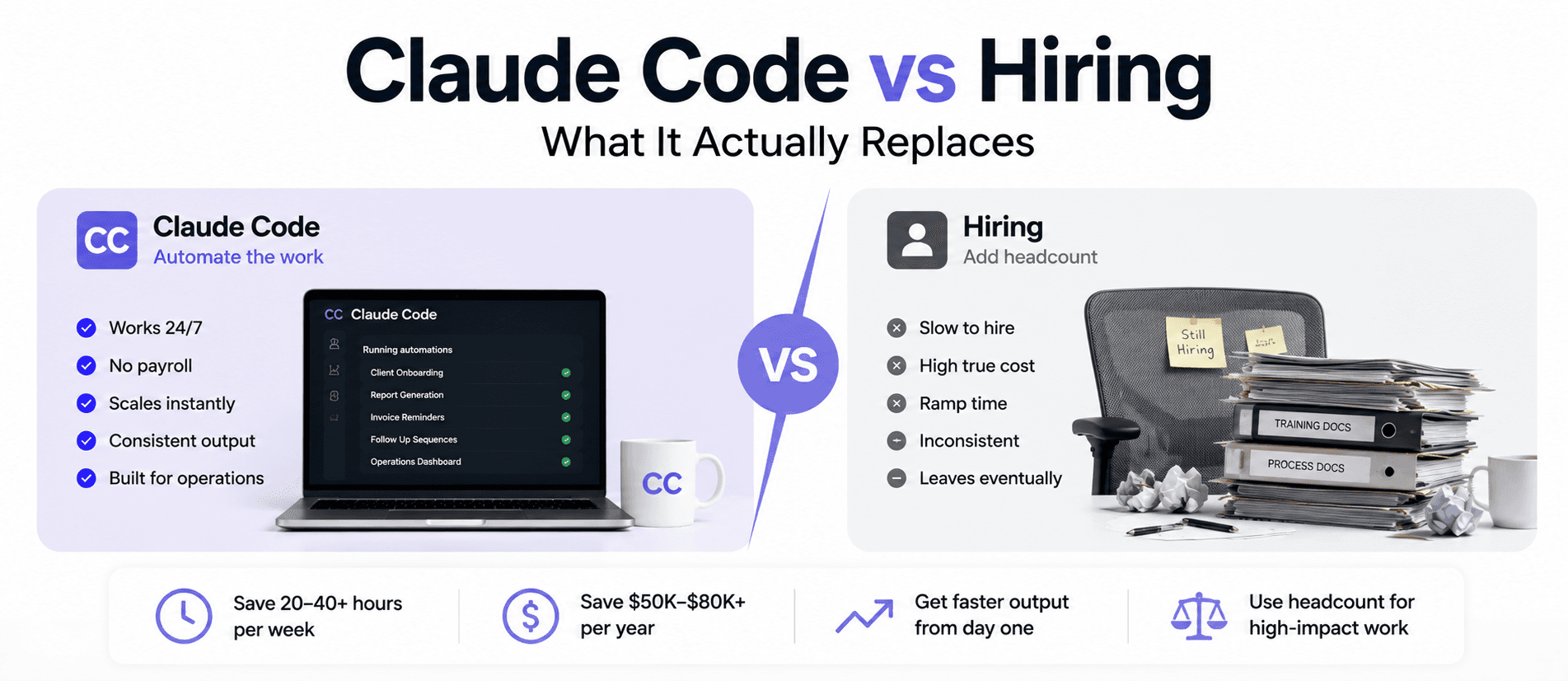
The question is not whether to hire or automate. It is which specific hours you pay $50/hr for…
Read more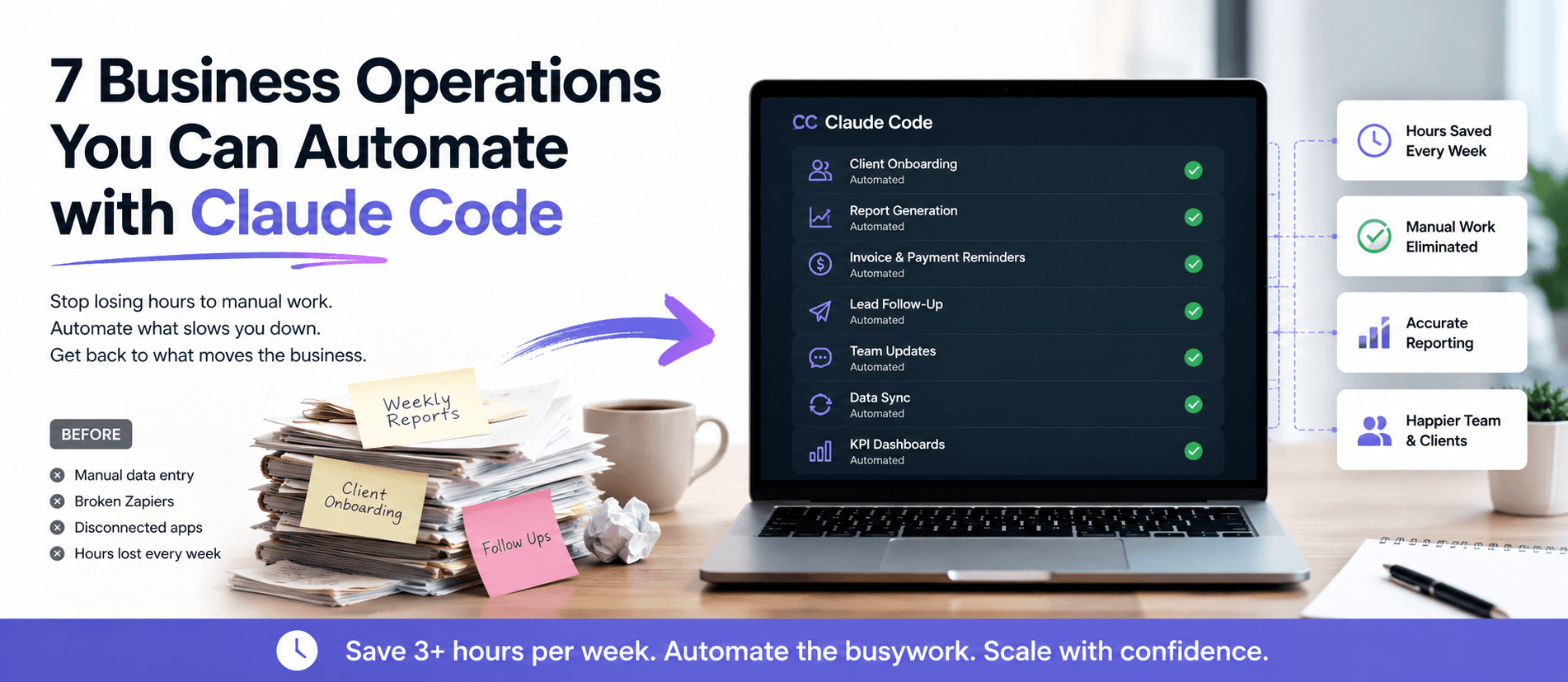
Your ops team spends hours each week on work that should already run itself. Here are 7 specific…
Read more